.png)
In Conversation With: Studio Nima
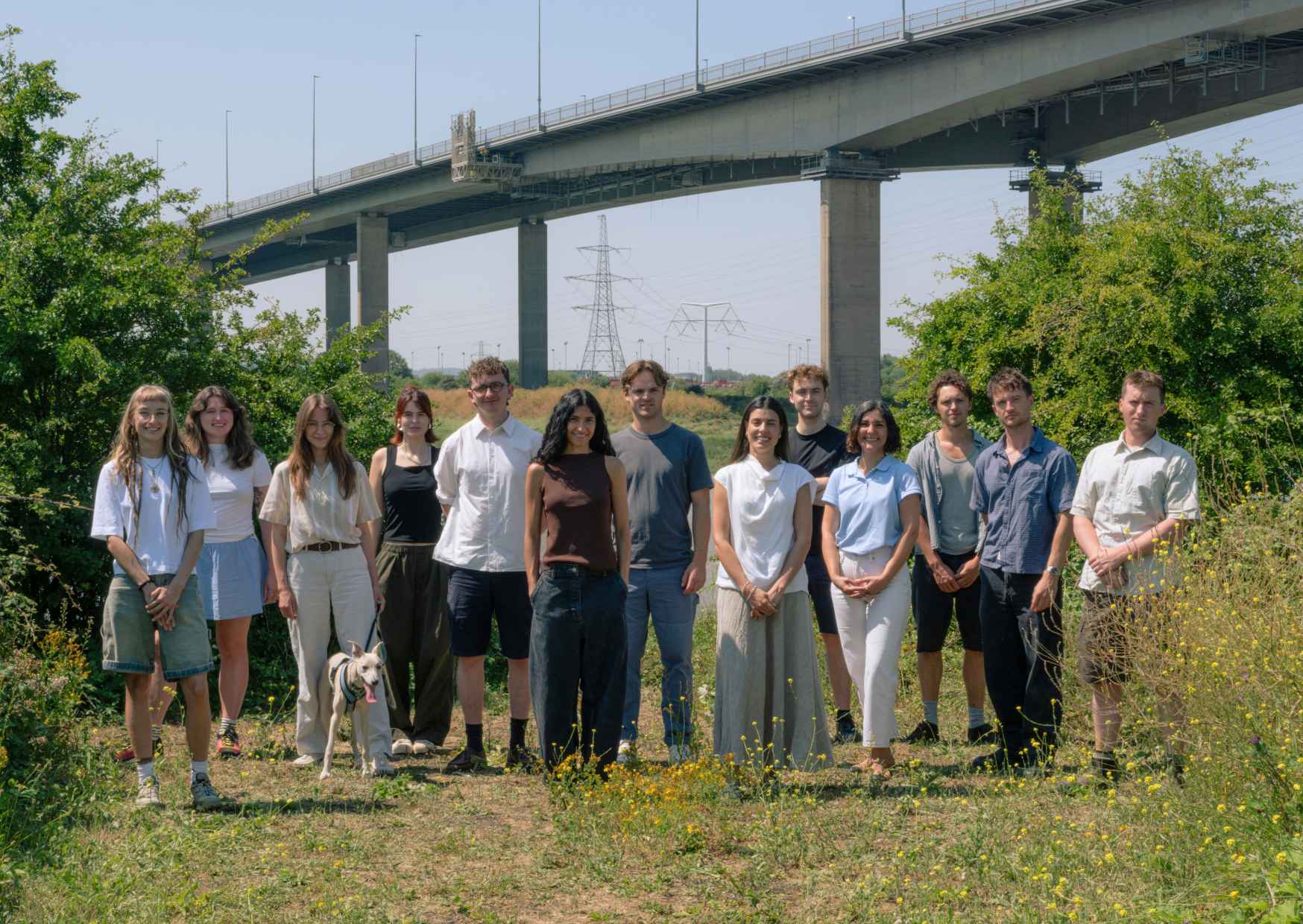
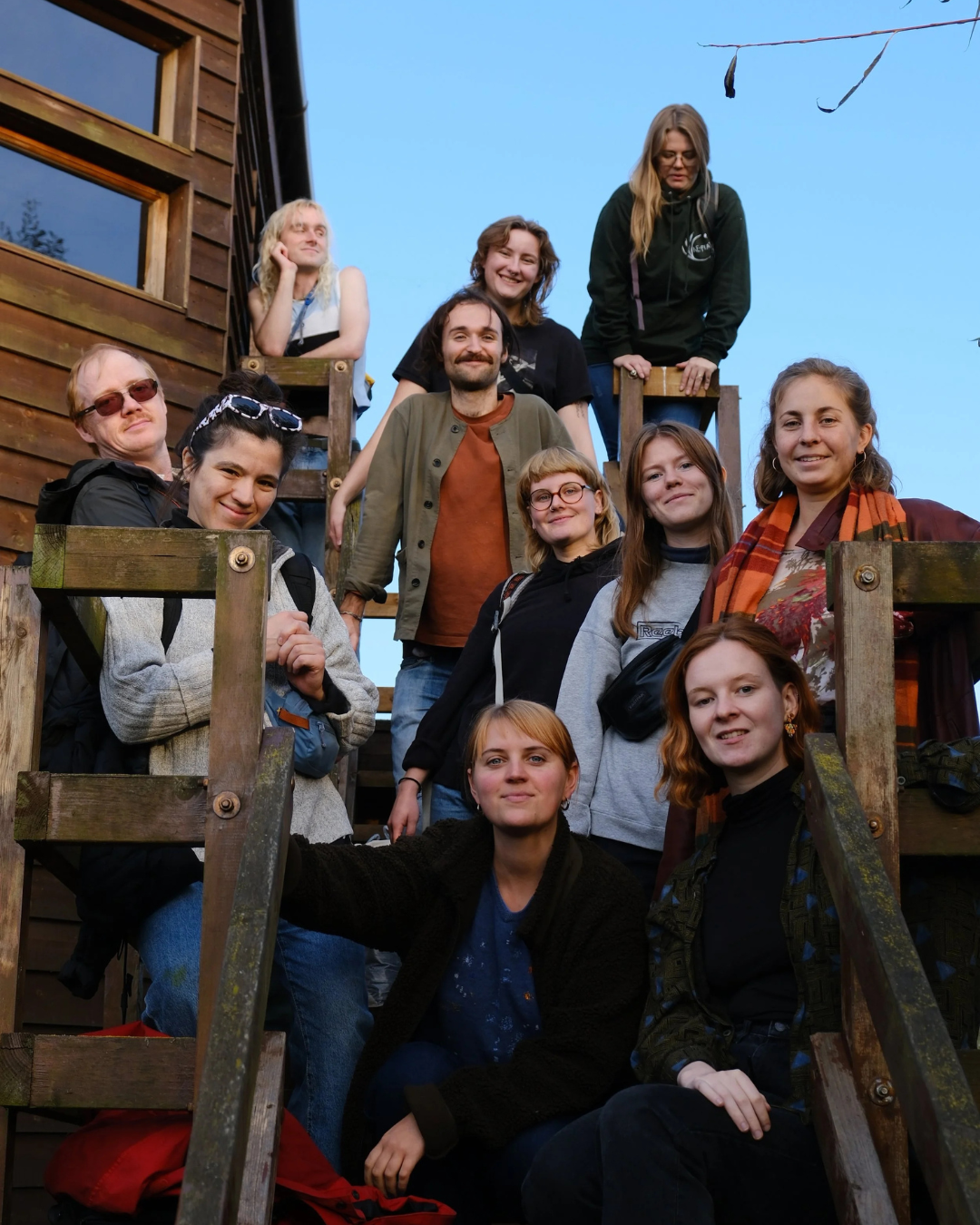
At Ponda, we have long admired the energy, creativity and determination behind RE-PEAT’s work. Their commitment to championing peatlands and the communities who depend on them - feels both urgent and deeply inspiring. RE-PEAT is a youth-led collective working across Europe, using creative advocacy to give peatlands the attention they deserve. Bringing together voices from art, science and activism, its members are united by a shared love for these vital ecosystems and a fierce commitment to protecting them.
Youth-led activism is essential in responding to the climate crisis, and it is always energising to connect with others who care about wetlands as deeply as we do. Over the coming months, we’ll be collaborating with RE-PEAT on a number of projects, but first, we wanted to introduce their brilliant team to the Ponda community. We’re delighted to sit down with them to explore how RE-PEAT began, the role of art in activism, and why peatlands deserve a much louder voice in the climate conversation.
To begin, could you share the story of how RE-PEAT first came to life? Where did the idea spark from, and how did it grow into what it is today? What are your best achievements in this time period?
Looking back now, it’s clear that September 2019 is a sort of BP and AP situation for a few of us: before peatlands and after peatlands. It was at this time that Bethany and Frankie were in Germany for a climate camp, which was set up to protest against a big chemical fertilizer company. They ended up spontaneously joining a peatland excursion and finding out about how vital peatlands are for the climate. On the bus ride home totally transfixed in this new mission, the name “re-peat” jokingly emerged. Since then, more and more people “re-peated” this moment of BP/AP, and so we formed a collective with many time-travelling multi-perspective starting points.
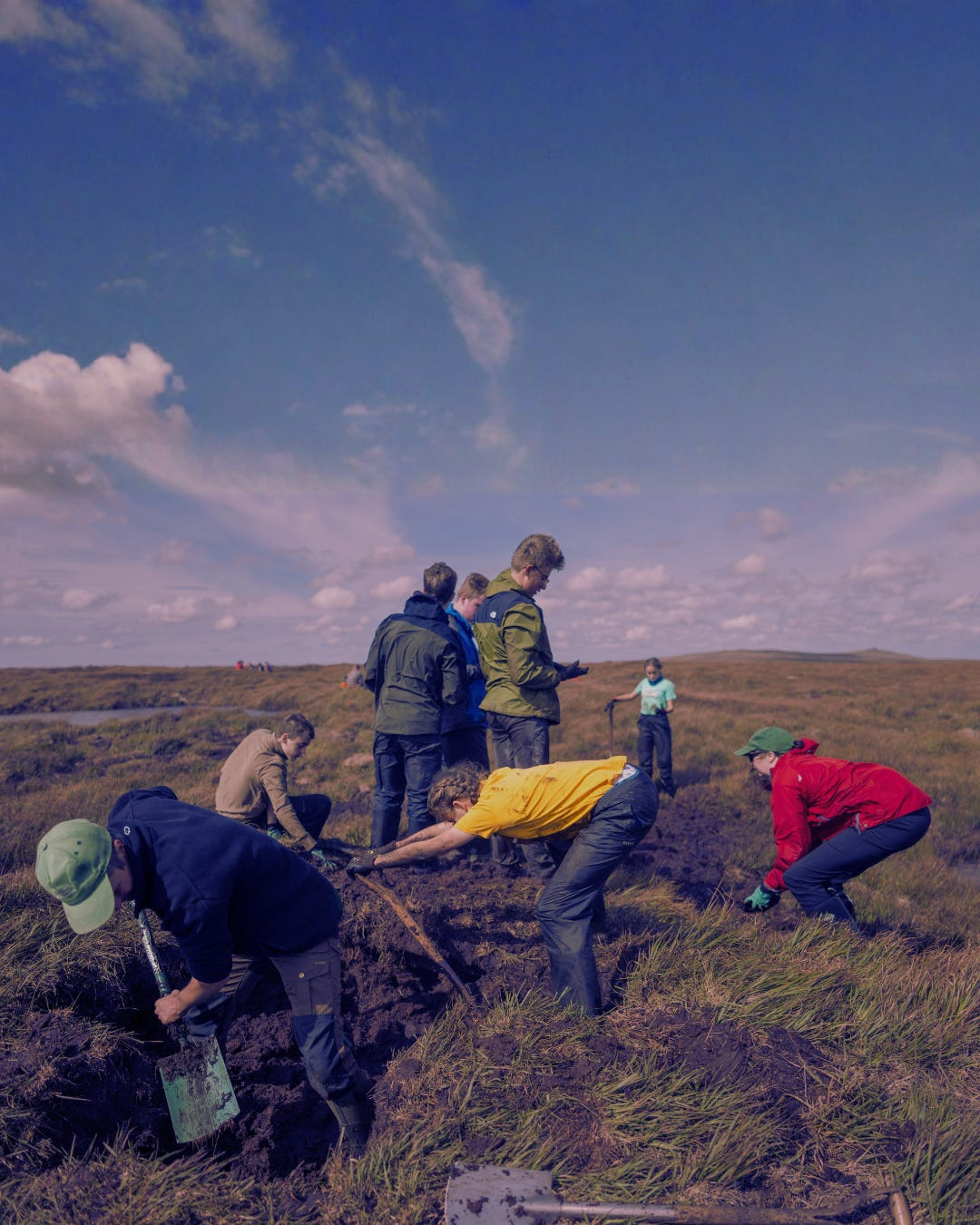
Over the course of the last five years together, we’ve learnt a lot more about peatlands. We have travelled across land and sea to visit them, listened to memories and built our own relationships with these landscapes. We’ve seen the importance of finding playful, metaphorical, collaborative, and imaginative ways of relating with peatlands and sharing their peculiar values. In return, the peatlands have guided us through explorations of grief, deep time, intergenerational thinking, migration, extraction, culture and more.
.png)
Since starting RE-PEAT, what is one of your favourite or most surprising things you’ve learned about peatlands?
People often think about peatlands as wet places, but when they are dry they become places that attract fire. Zombie fires can smolder underground for weeks, months and in some cases years… waiting in the shadows for the right moment to emerge into the light and reignite the world above. The idea of zombie fires is totally ominous, but also strangely magical in the way that they escape our view and our control. This is why peatlands, when kept wet and healthy, are such important mitigators of fire and drought. With their absorbent properties, they can also help prevent flooding. Peatlands are vital, intelligent regulators of landscapes, they are ecosystems we urgently need to care for and protect.
Wetlands and peatlands are often overlooked in climate discussions. Why do you think they remain so underrepresented, despite their huge ecological importance?
Wetlands and peatlands are often overlooked in climate discussions because of how they have been framed culturally and politically. They are frequently portrayed as wastelands, as “scary” or “empty” places. As landscapes to be drained rather than valued, making their ecological richness easy to ignore. Their degradation is also a form of slow violence: like the frog in hot water metaphor, the impacts unfold gradually and go unnoticed until it’s too late. For example in the Netherlands, soil subsidence from drained peatlands happens slowly, yet over time the land sinks by meters. Restoring peatlands is also slow. It requires landscape-wide agreement and collaboration between many actors, which is far harder to organise than restoration efforts focused on a single plot of land, such as forests.
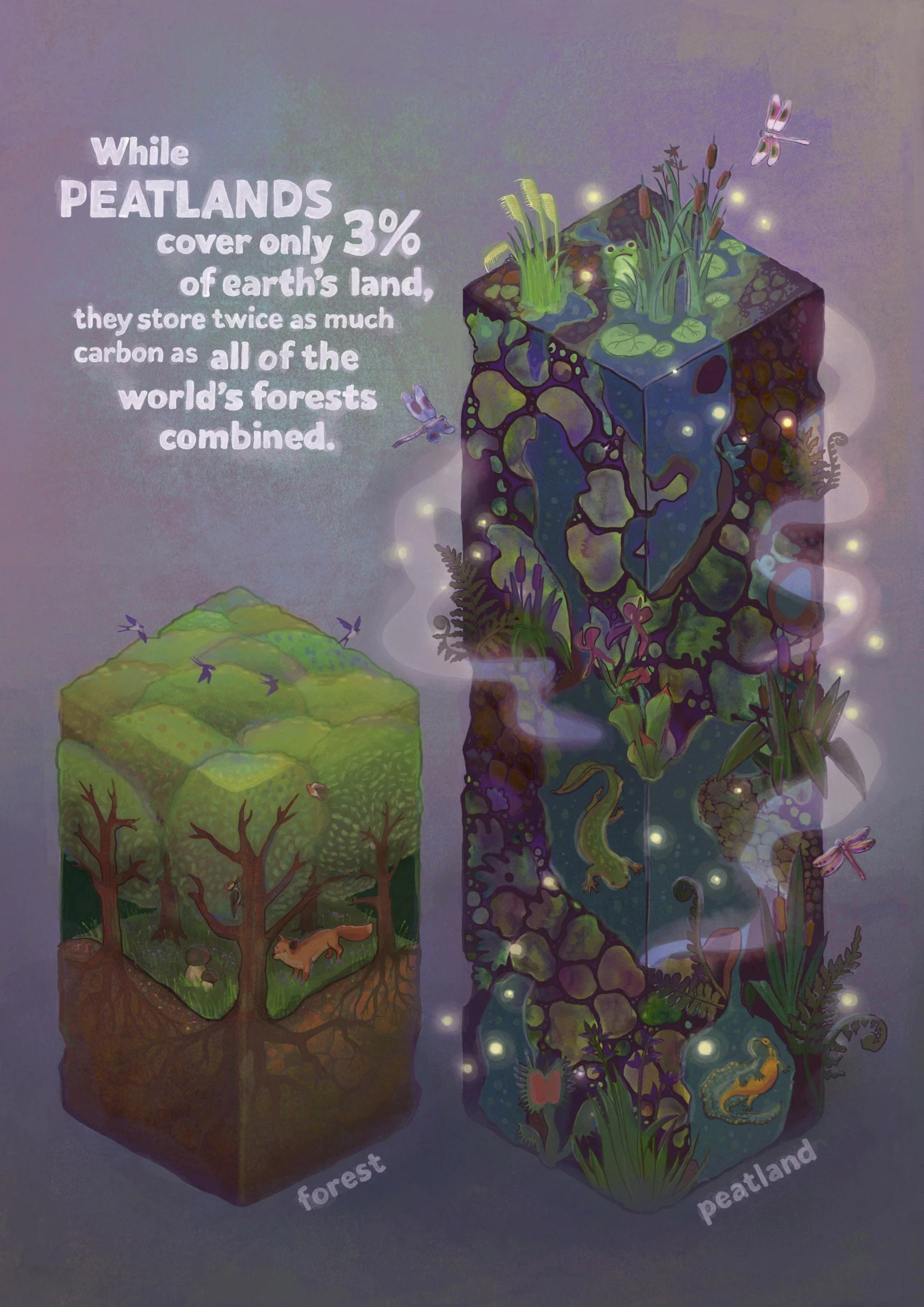
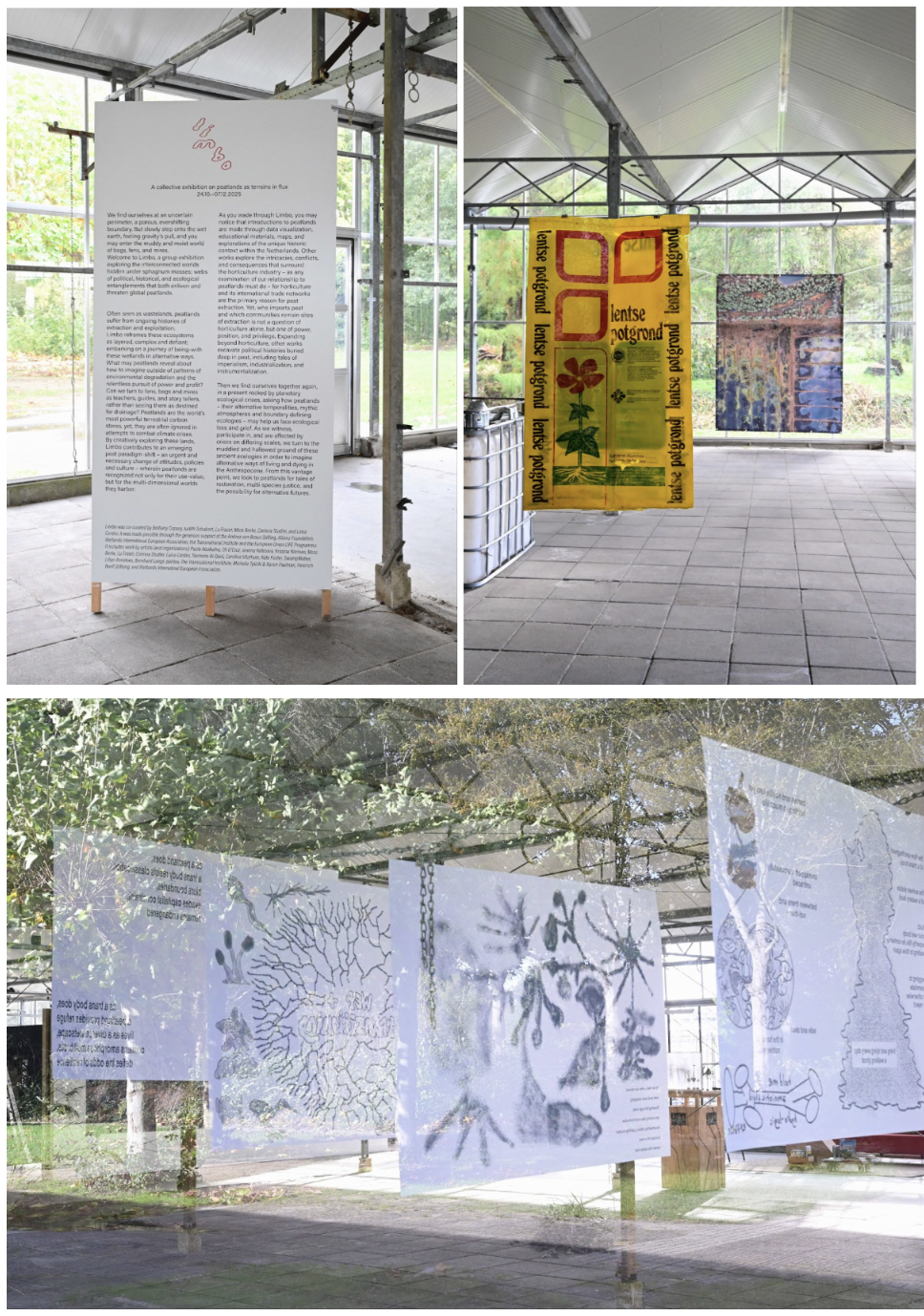
We delivered one of the largest peatland exhibitions to date, Limbo, created in collaboration with De Proef, a former horticultural school in the peat-rich province of Drenthe in the Netherlands. Inspired by the region’s long history of peat extraction, the exhibition brought together over 25 artists from around Europe, working across sound, data, video, and cartography to present peatlands as culturally complex landscapes rather than mere carbon stores. Alongside the exhibition, we hosted side-programming including lino-printing, artist talks, and a paludi dinner, pairing historical context with clear calls to action and significantly expanding the cultural and political visibility of peatland justice in the Netherlands.
The crowdfund supported the exhibition on a limited budget, ensuring fair artist compensation and enabling an interactive public programme, documentation, and a booklet that extends the work beyond the exhibition itself. Through over 200 pledges we reached just over €10,000! We are deeply grateful for the global network of supporters who made this possible.
Images from the Limbo exhibition taken by Caroline Vitzhum
By Liv Symes
Studio Nima is a social innovation and social business studio based in Munich - but calling them a “studio” doesn’t quite capture what they do. They combine research expertise, analytical skills, and a network of leading thinkers to turn bold ideas into real-world solutions that make a tangible impact. What sets them apart is their ability to bring sustainability to life, creating experiences that people can see, touch, and interact with.
We’ve been lucky to work with Studio Nima on a number of creative sustainability projects, and last year took us back to Munich for two particularly exciting collaborations: the Bio Living Lab exhibition at the Deutsches Museum and the Material Lab at ISPO. Every time we work with Leonhard Nima and Szimona Zaharieva, we’re inspired by their infectious passion for material innovation and sustainability.
In this blog, we sit down with Leonhard Nima, Founder of Studio Nima to uncover how Studio Nima came to be, the stories behind their projects, and what lies ahead in their journey to bring green innovation to the world.
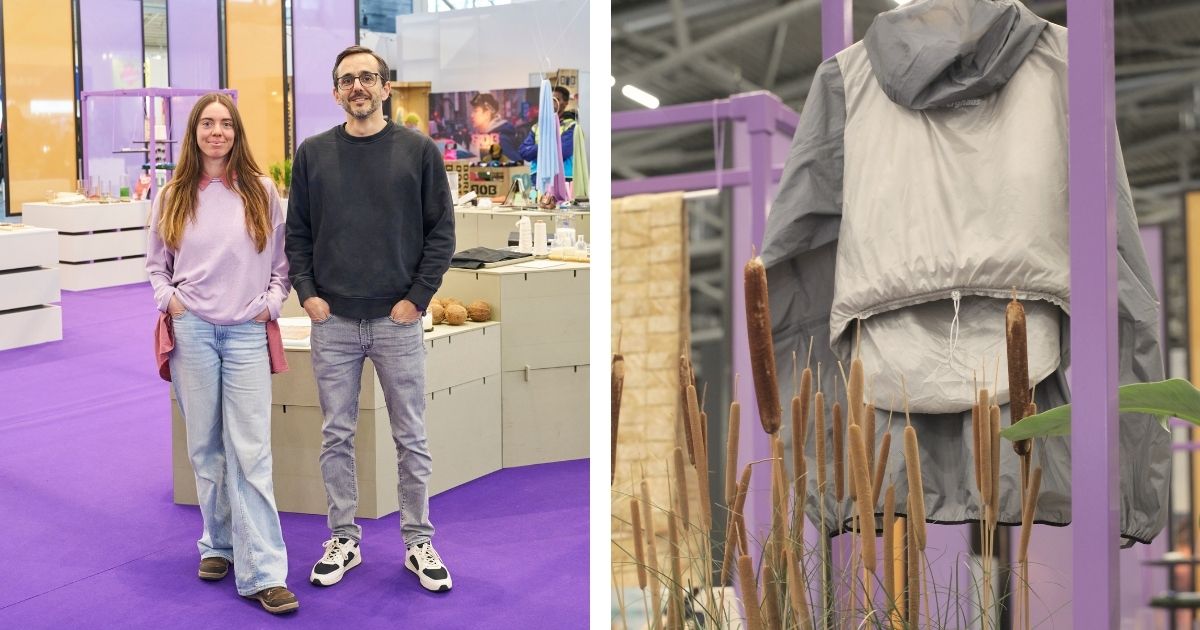
For anyone who hasn’t come across Studio Nima before, how would you describe your purpose and the philosophy behind your work?
For us at Studio Nima we set a strong focus on creating social or environmental impact and all of our projects aim to contribute to one or more of the Sustainable Development Goals. We therefore cover a broad range of topics and projects all around impact, which also means that it is not so easy to explain our work in just a sentence.
Just to give you an idea, our projects range from topics such as youth engagement strategies, gaming for democracy, future of mobility solutions, traceability solutions in agriculture, and of course a lot in the field of circular economy and biobased materials. It is part of the philosophy of our work to find connections between such a diverse range of topics. This is where the innovative nature comes to life.
You work across so many sectors and countries - what does your creative process look like when you begin shaping a new project or exhibition?
There is certainly not only one approach to what our processes look like. While you would assume that all processes start with a concrete and well-defined problem, that is not always the case. Sometimes it is all about an initial idea that we feel can be worthwhile to further explore.
Ideally, such ideas are then based on a hypothesis of how it could lead to social or environmental impact in one way or another. I would also say that in most cases, the process is a very iterative process, where you constantly keep refining things, in terms of the problem definition and the actual solutions. And certainly, the process is characterised through collaborative work that closely involves our partners as well, which make it even more dynamic and fun.
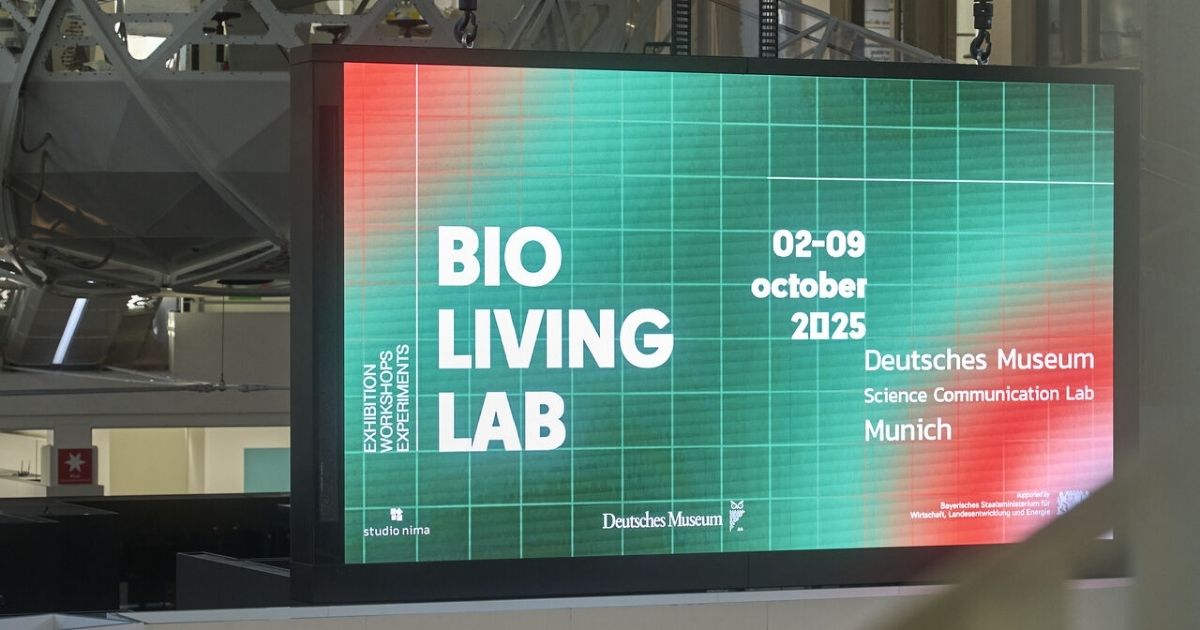
We’ve collaborated on several projects now - Bio Living Lab and Material Lab included. From your perspective, what makes Ponda’s materials a good fit for the way Studio Nima works?
We for sure like the Ponda material a lot. It is not only an innovative and unique material solution, but we specifically also like the regenerative aspect and more holistic approach that you take at Ponda.
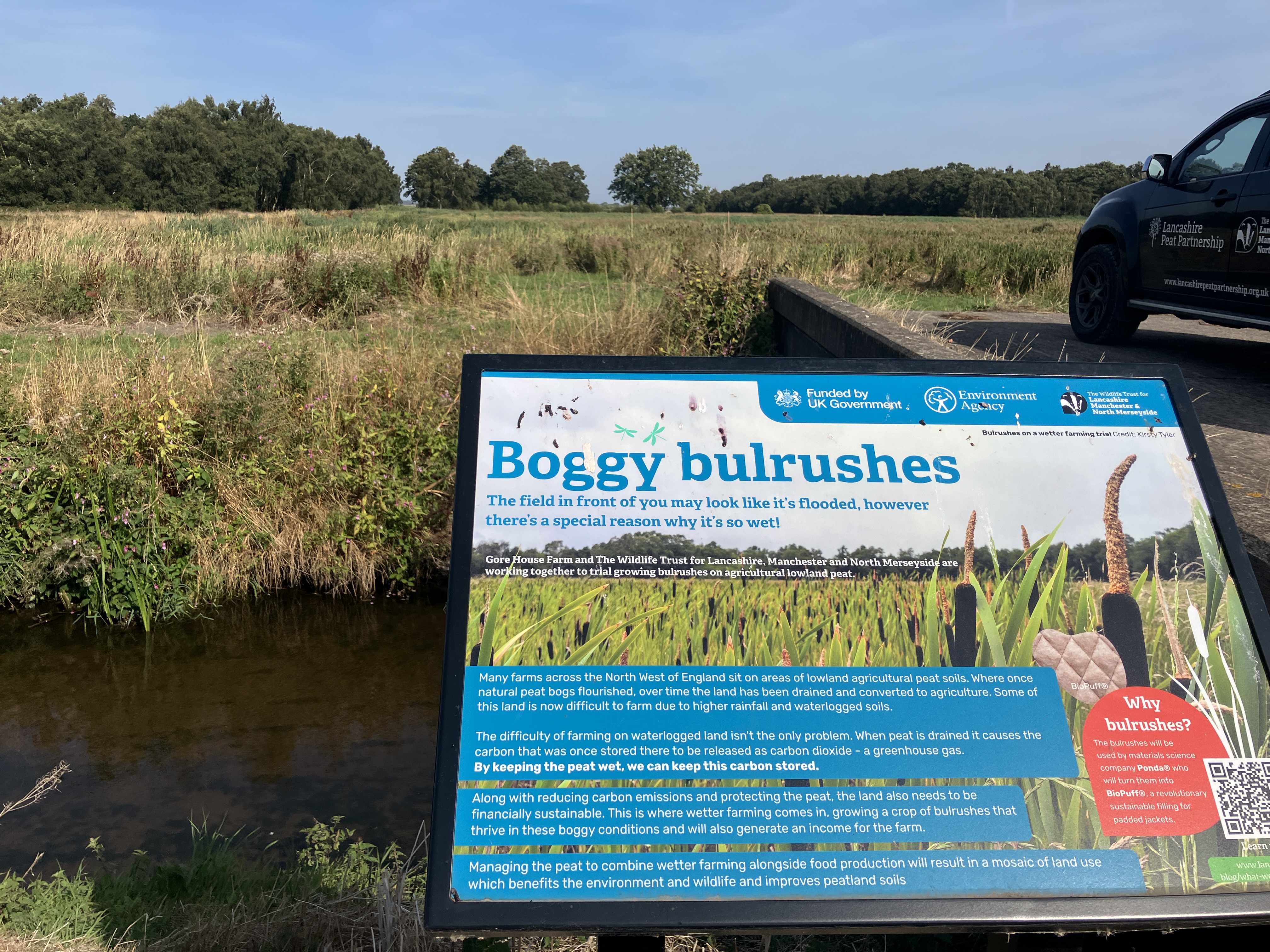
It is really a great and tangible example of an innovation approach that creates impact more holistically and to show and teach people about the journey from the typha growing in wetlands, through various processing steps, all the way to a finished product such as a jacket. This is really powerful to get people educated and excited at the same time.
The Bio Living Lab and Material Lab both encourage people to engage directly with materials. Why is hands-on interaction so important to your approach?
We believe that we need to put a strong emphasis on highlighting solutions that do have a positive social and or environmental impact. It is crucial not only to talk about such solutions, but to really have hands-on interaction and feel.
First of all, it is crucial to show the respective materials and products, but also all the important steps from nature, to the various processing steps, to the material(s) and even their applications. This really helps people to connect the final material to the natural biobase and that's where they make the connection.
The second very important aspect in our Bio Living Lab is the practical part with lots of different educational formats and workshops where participants directly work with materials in order to create products and prototypes themselves. This even enables a much deeper understanding of how nature can provide us with fantastic and exciting solutions.
.png)
What trends or innovations in sustainability and circular materials are you most excited about right now?
It is certainly great to see a broad range of materials that are currently being developed for all these different applications and use cases, but also from a multitude of feedstock. There is certainly an overall trend of new material innovations.
But there are of course downsides as well, we have recently seen some setbacks with failures, sometimes due to material properties, sometimes for business and economic reasons. To some extent that is to be expected, as it happens pretty much in any field that startups are operating in, but then 2025 has been also a challenging year for sustainability topics in general. That’s why endurance, stamina, dedication and commitment remain crucial success factors for many startups in the material field.
And our perception is that the field of material innovations is still very small in regards to its importance and size it could have. Let’s hope we will see some major breakthroughs in the next few years.
.png)
And on a personal note - what excites you most about continuing the Studio Nima × Ponda partnership in the future?
For us it is of course exciting to get creative together and to think about inspirational ways and design of how to convey the message of regenerative solutions both in a visual way but also in terms of messaging.
We can envision developing some educational formats, where participants dive deeper into the topic of wetlands and regeneration and for example would be able to produce small little solutions themselves, from harvesting typha to making a small prototype jacket…wouldn’t that be cool!?
-
Studio Nima continues to remind us that sustainability isn’t just a concept - it’s something people should be able to experience, question, and feel. Their work brings complex ideas to life in a way that sparks curiosity and conversation, and we’re proud that Ponda’s materials play a part in that journey. As we look ahead to future collaborations, we’re excited to keep exploring how regenerative materials can inspire new ways of thinking, designing, and living.
Follow on Instagram - @ _studio_nima_
Linkedin: https://www.linkedin.com/company/studio-nima/posts/?feedView=all
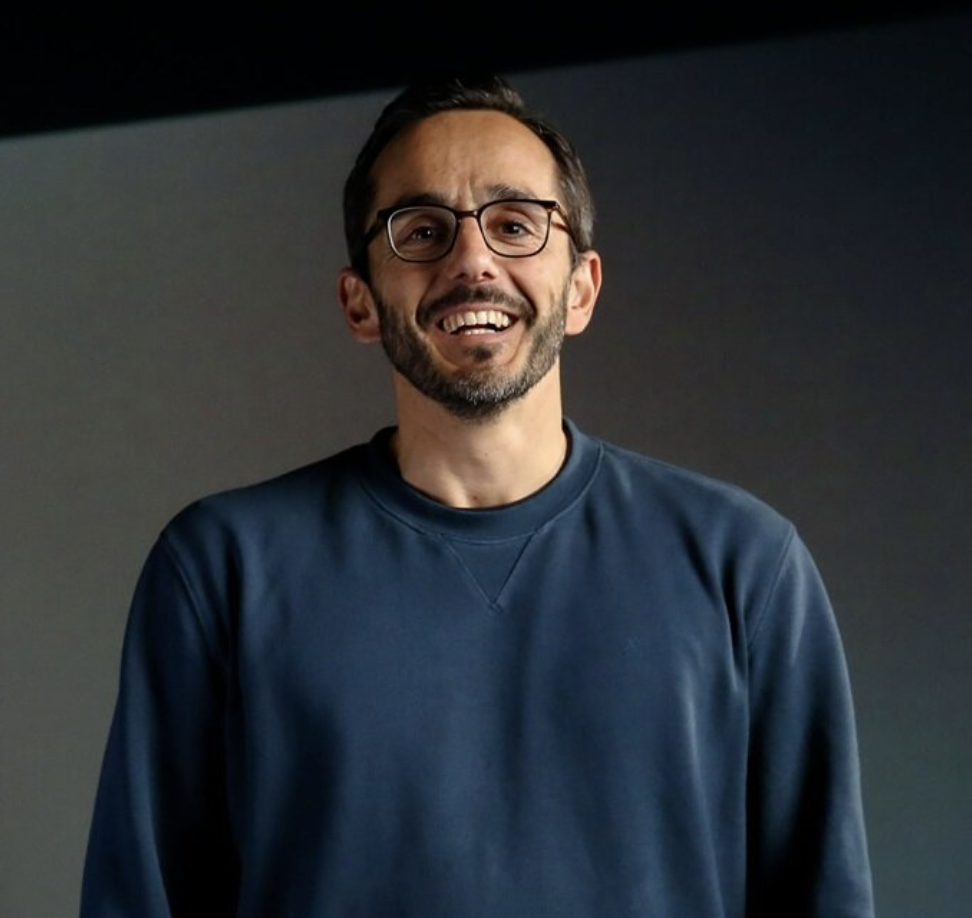
Leonhard Nima, Founder of Studio Nima
Leonhard has more than 15 years of social innovation experience in 20+ countries. He is the Founder of Studio Nima and Co-Founder of N3XTCODER.
He serves as Educational Advisor to the Yunus Sports Hub. Leonhard acts as an expert and mentor in various incubation and acceleration programs for the International Olympic Committee and the BMW Foundation. He works as a moderator at international conferences. He was an Adjunct Professor at the Master of Social Entrepreneurship at Hult International Business School in San Francisco & London. Leonhard worked as Head of Academia at The Grameen Creative Lab for Nobel Peace Prize Laureate Prof. Muhammad Yunus. Previously, he worked for the management consulting company Accenture.
Connect with Leonhard
.png)